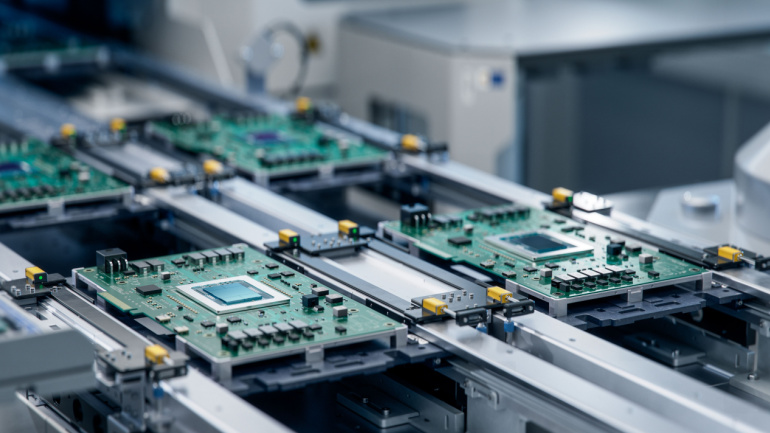
In the ongoing technological rivalry between the United States and China, Huawei has emerged as a significant beneficiary, particularly in the realm of artificial intelligence (AI). The U.S. government, in its persistent efforts to hinder China’s progress in AI development, has implemented various bans on the sale of certain products from American companies to their Chinese counterparts. The focus of this battle shifted notably to AI over the past year, with China positioning itself as a frontrunner in AI, albeit still relying on U.S. company Nvidia for crucial high-performance chips.

In a recent announcement, chip manufacturer Qualcomm has introduced the latest iteration of its immersive technology, the Snapdragon XR2+ Gen 2. Boasting advancements in mixed reality (MR) and virtual reality (VR), the new chipset is set to power future VR innovations from tech giants Samsung and Google.
In the narrative of AI revolution, the telecom sector often remains overshadowed. Juniper’s ‘Top 10 Telco Trends 2024’, highlights how AI dominates even in this crossroads digital landscape. However, a critical question evolves – is our telecom infrastructure ready to steer the AI wave? As we plan to create AI-powered golden era, it’s imperative that our static infrastructures are fit for purpose to manage this data deluge.
In a collaborative effort organized by the National Institute of Information and Communications Technology (NICT), major Japanese companies DoCoMo, NTT, Sky Perfect JSAT, and Space Compass are set to pioneer direct-to-device (D2D) services utilizing flying base stations.
The race for 5G supremacy is intense, and LexisNexis IPlytics explores the landscape in their 2023 report. CEO Tim Pohlmann notes a significant surge in 5G patents, with the top 10 players owning 76% of declared patent families. The US leads in patent volume, followed by China and Europe. Huawei dominates the top 50 ranking. Pohlmann emphasizes the role of Chinese companies, particularly Huawei, in shaping the 5G sector, extending their influence to the automotive industry
Cellnex, the infrastructure titan, is considering the sale of tower assets in Austria and Ireland in a push to offload financial burdens and deepen roots in the European market. This shift in focus, triggered by last year’s UK Hutch deal completion, aims for organic growth, investment-grade rating, and debt management via strategic divestments. CEO Patuano hints future cash generation post 2027 and potential interest in bidding for Deutsche Telekom’s GD Towers business, crafting a more efficient operational blueprint.
The UK government’s recent decision to continue a tax exemption policy marking network gear costs as deductible pre-tax profit boosts established telecom firms like BT, although smaller enterprises might not see similar benefits. This fiscal initiative heavily benefits BT in their £15 billion full-fibre project, increasing their capital spending by £300 million annually, expediting their fibre rollout to 25 million homes by 2026.
Japanese telecommunications giant NTT Docomo is set to revolutionize its commercial network with the adoption of Nokia’s Open RAN compliant 5G AirScale baseband kit. The comprehensive deployment includes both Centralized Unit (CU) and Distributed Unit (DU) software, emphasizing Nokia’s industry leadership in the mobile communication sector.
IDC predicts a promising future for the semiconductor industry, driven by AI advancements and a stock level recovery. With a refreshed outlook signaling sustainable growth, the firm anticipates global chip revenue of $526.5 billion in 2023. Progress can be seen in the revised revenue forecast for 2024, hinting at a 20.2% year-on-year growth to $633 billion.
As the year draws to a close, the Radio and Internet Services Department (RDI) is inching closer to launching private local spectrum licenses for enterprise clients. Set to equip them with the 3.5GHz spectrum and power the assembly of private 5G networks, this promises to transform sectors such as Virtual Reality and autonomous vehicles. However, some concerns have borne by airports and ports on fair allocation.