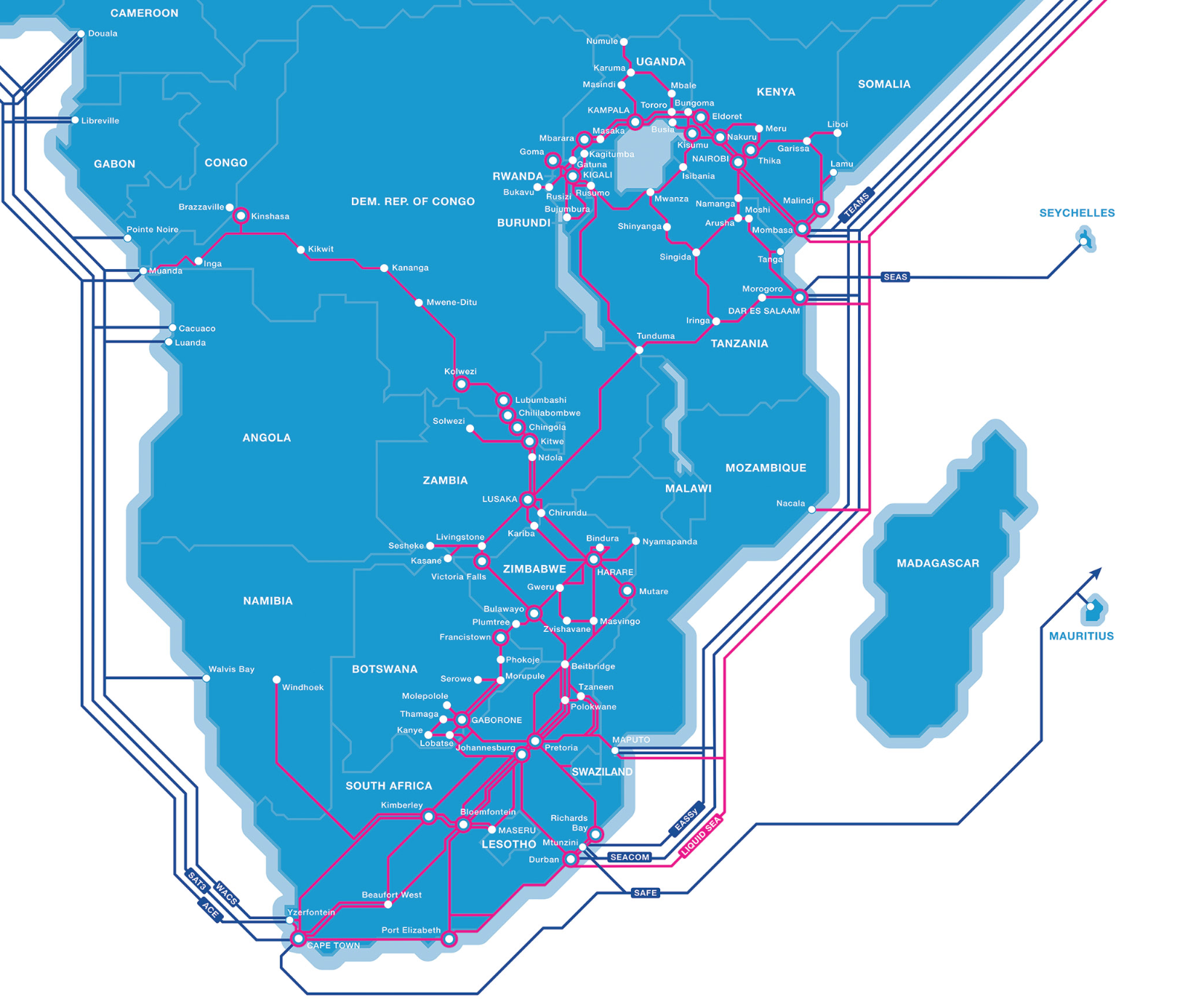
CTG (China Telecom Global) and Liquid Telecom (a pan-African telecom company) signed a deal to collaborate in the development of network solutions and services. In Johannesburg, Liquid Telecom’s headquarter held the signing ceremony between the Chinese and the African companies. Senior Representatives from China Telecom Donald Tan and Changhai Liu, and Liquid Telecoms CEO Nic Rudnick, and Chief Business Development officer Willem Marais, were present for this event. The two companies will be able to provide to their customers an extended coverage on those two parts of the world. “With more than 50 countries in the region, Africa is nonetheless the booming new market with the highest development rate just after Asia, and a very important market for CTG.” said Changhai Liu. As the Managing Director of China Telecom (Africa and Middle East) he also added, “This collaboration will enable both CTG and Liquid Telecom better serve our customers and…
China Telecom (China Telecommunication Corporation) and HGC (formerly Hutchinson Global Communication) will be working together in building a carrier-to-carrier fiber optic connection on the Hong Kong-Zhuhai-Macau Bridge. HGC, founded in 1992 under British ruling, is the leader in fixed-line operators. It also has an extensive number of infrastructures outside of Hong Kong. It is also one of Hong Kong’s main Wi-Fi provider with 29,000 hotspots. It is now owned by I Square Capital, under Asia Cube Global’s infrastructure. On the other hand, China Telecom is the most important state-owned telecommunication company in China. It manages the third largest broadband network in the world. Their internet offers has 160 million subscribers, and the customers’ number of their mobile service is 260 million. This Bridge connects Zhuhai, up north Macau, Macau itself and Hong Kong. It is set to open for vehicles on July 1rst 2018. It will also be used for…
Global 5G growth is reshaping VoIP, fixed wireless access, and enterprise connectivity, but standalone 5G adoption still lags. With only 98 operators launching 5G standalone, network slicing, RedCap devices, private wireless, and low latency VoIP services depend on faster core upgrades, broader coverage, and stronger operator investment worldwide for businesses
Nokia’s AI infrastructure surge is reshaping VoIP, IP networking, and cloud communications demand as data centers accelerate optical investments. With Infinera boosting capacity and AI-RAN plans targeting 5G and 6G, Nokia’s growth looks powerful, but chip shortages, margins, and commercial execution will determine whether momentum becomes long-term telecom success ahead.
AI glasses shipments surged 127% in 1H26, signaling new opportunities for VoIP providers, telecom operators, and 5G networks. As wearables add cameras, audio, translation, and live assistance, they could reshape data traffic, edge computing demand, and enterprise communications while raising urgent privacy, security, and connectivity challenges for businesses worldwide today.
USTDA-backed THUS subsea cable could transform VoIP connectivity between Thailand, Southeast Asia, and the United States. By avoiding the South China Sea, the 18,500-kilometer route promises lower latency, stronger network resilience, secure cloud access, and expanded international capacity for carriers, data centers, AI platforms, and business communications across Asia-Pacific markets.
Thailand’s AIS, True and NT are rolling out low-cost mobile data bundles to boost TH-AI Passport adoption, showing how telecom operators shape digital access. For VoIP providers and communications businesses, the move highlights a growing link between affordable connectivity, AI services, bandwidth demand and the future of Asian networks ahead
Qualcomm’s 6G and AI roadmap signals a major shift for VoIP, mobile connectivity and real-time communications. AI-native networks promise smarter traffic management, stronger uplink capacity and support for wearables, assistants and immersive calling. As spectrum planning accelerates, telecom operators must prepare for data-heavy AI devices and next-generation VoIP demand growth.
Global RAN spending is shifting beyond China as operators accelerate 5G upgrades, capacity expansion, and modernization. Strong growth across emerging markets creates new opportunities for carriers, vendors, fixed wireless, enterprise connectivity, and VoIP services. Omdia’s latest data highlights regional momentum, vendor competition, and the evolving business case for mobile networks.
Huawei and Shaanxi Culture Industry Investment Group are bringing AI-powered tourism to Xi’an with BoGuan, a multimodal LLM backed by 5G Advanced connectivity. For VoIP providers, the project highlights how high-speed networks, cloud communications, and AI voice assistants can transform visitor engagement, multilingual guidance, and digital cultural experiences at scale.