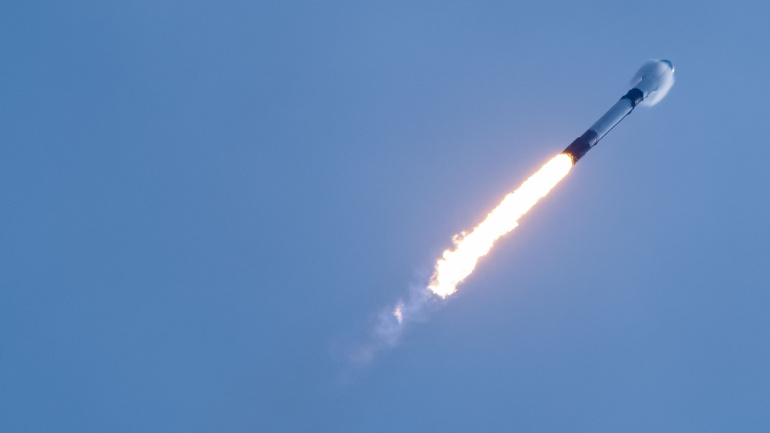
In a groundbreaking collaboration, T-Mobile US and SpaceX are gearing up for the field testing of Starlink satellites, heralding a significant stride in eliminating mobile coverage dead zones. While the exact date for the commencement of field testing remains undisclosed, T-Mobile is optimistic about its imminent initiation, stating that the low-Earth orbit deployment of satellites sets the stage for the forthcoming trials.
In a strategic move to gain a foothold in India’s expanding telecommunications market, Elon Musk’s satellite communications constellation, Starlink, is reportedly considering a stake in Vodafone Idea (Vi). As of 2024, Starlink boasts a constellation of over 5,500 low Earth orbit (LEO) satellites, providing commercial services in more than 60 countries to approximately 1.5 million subscribers.
SpaceX’s Starlink project faced a setback this week as the Federal Communications Commission (FCC) voted 3-2 to maintain its decision to deny funding from the Rural Digital Opportunity Fund (RDOF). The initial award in late 2020 aimed to extend broadband coverage to nearly 643,000 premises in 35 states.
The FCC recently reiterated its denial of Starlink’s bid to gain nearly $900M in support from the Rural Digital Opportunity Fund program. Despite Starlink’s impressive technology, FCC Chairwoman Jessica Rosenworcel questioned the wisdom in subsidizing the still evolving tech until 2032. Starlink had initially received the lofty sum in a 2020 auction but was later deemed inadequate in verifying its capabilities.
Intriguingly, SpaceX’s Starlink offers an innovative Direct to Cell feature allowing existing LTE phones to function even in remote locations – a potential boon for those often out of terrestrial coverage. With a rollout plan targeting texts by 2024, and full voice, data, and IoT compatibility by 2025, Starlink seems poised for a breakthrough. While the proposition seems formidable, concerns around possible limitations of Starlink’s proprietary technology remind us advantages of relying on industry best practices. Without disclosed pricing details, we can only anticipate how this venture will fare against other satellite connectivity contenders.
Delving into satellite technology, Telefónica forms a strategic alliance with Starlink to enhance global connectivity, specifically targeting rural and hard-to-reach regions. With initial implementation in Mexico, this high-speed internet service is set to expand to five more markets, indicating a promising shift in accessible global digital inclusion. But is this the harbinger of a new connectivity era or just a companion to existing solutions?
stra, the Australian telecommunications company, has announced a new partnership with SpaceX’s Starlink, a Low Earth Orbit (LEO) satellite constellation. The collaboration aims to provide home phone and broadband services to customers in remote areas. Telstra’s satellite connectivity services will offer expanded options for businesses and consumers who previously had limited access to broadband, potentially bringing them online for the first time.
Elon Musk’s ambitious plans to bring Starlink to India face challenges amidst spectrum policy clashes with local telecom operators. As the competition heats up in India’s satellite communication space, the sector’s future remains a hot topic.
Starlink, SpaceX’s satellite internet service, is developing a service offering named Global Roaming Service. This service would allow customers to access the Internet from practically anyplace on Earth. The service will cost $200 each month in addition to the $599 Starlink Kit, according to a statement addressed to Starlink subscribers. Starlink employs inter-satellite connections, or space lasers, to enable global connectivity. As such, users can expect the service to be interrupted with brief periods of weak or no connectivity. Despite the promise of access to the internet almost everywhere, Starlink is still awaiting regulatory clearance in numerous countries, including India, Pakistan, and Cambodia. The current $135 a month Starlink RV plan allows users to equip their RVs with Starlink’s hardware for internet connection while traveling. However, it is only available in specific regions of the world, and internet connectivity is not prioritized as it is for residential customers.…

T-Mobile is collaborating with SpaceX to expand its network coverage. Last week, the two businesses announced that they will collaborate to provide extensive cellular access, including full coverage in most parts of the United States. The collaboration seeks to beam down connectivity using SpaceX’s fleet of low Earth orbit satellites for the benefit of T-Mobile customers. With this initiative, T-Mobile consumers should be able to connect to the SpaceX satellites through a new network, transmitted from Starlink’s satellites utilizing T-Mobile’s midband spectrum across the country. SpaceX currently provides home internet access globally through its Starlink program. Even though T-Mobile hasn’t yet provided details on the network’s deployment, the company claims that this collaboration should provide nearly complete coverage almost anywhere in the US. The two companies intend to provide this service in order to replace the use of satellite phones in off-the-grid locations such as national parks or…