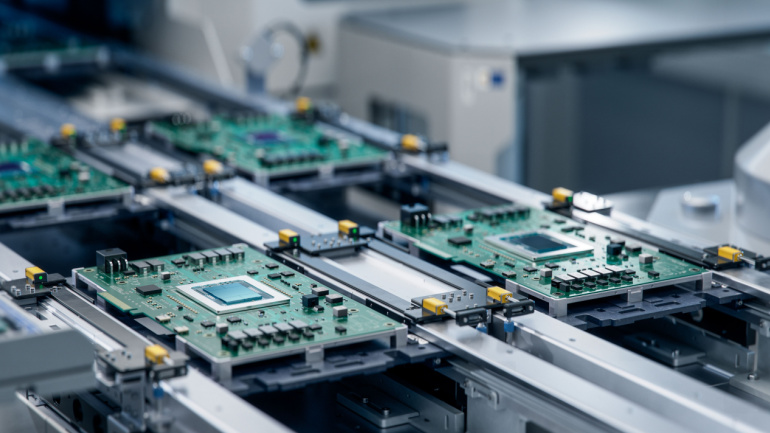
IDC predicts a promising future for the semiconductor industry, driven by AI advancements and a stock level recovery. With a refreshed outlook signaling sustainable growth, the firm anticipates global chip revenue of $526.5 billion in 2023. Progress can be seen in the revised revenue forecast for 2024, hinting at a 20.2% year-on-year growth to $633 billion.
The UK’s Department for Science, Innovation and Technology earmarked £36 million from its budget for 10 regions, highlighting a drive towards 5G innovation. Projects range from enhancing port operations to supporting advanced manufacturing and boosting tourism. However, an interesting aspect to note is the unique applications, including agricultural advancements in Sussex and the creation of 5G science parks in Oxfordshire.
Just under a year ago, the tech world buzzed with anticipation over a new partnership between chip mogul Qualcomm and satellite firm Iridium. The aim? Integrating satellite-to-phone services via Snapdragon Satellite and Iridium’s resources. However, a recent shift in direction caught the industry’s attention. Despite a successful demo, smartphone manufacturers didn’t opt to incorporate this feature, leading Qualcomm to end the agreement. Yet, in the face of disappointment, Iridium remains optimistic, envisaging an industry veering towards greater satellite connectivity. As earthquakes ripple across the telecoms landscape, all eyes await what’s next.
As the digital revolution persists, Communication Service Providers (CSPs) are redefining traditional revenue streams, with data monetisation being key to their success. CSPs have transitioned from solely facilitating connectivity to enabling fascinating digital technologies. They’re effectively tapping into the vast quantities of data from their networks to drive valuable insights. For instance, Vodafone Portugal, aided by Celfocus, successfully converted raw data into significant insights to improve operational effectiveness.
Emerging from the tech world, the AI Pin—an innovative, screen-free wearable gadget—incorporates artificial intelligence to facilitate verbal engagement and numerous other unique functionalities. Embedded into a shirt, it provides easy, hands-free access to information and personal communication. It features an unusual ability to support nutritional goals, leveraging computer vision technology to identify various food items. Functioning on the tailored OS, Cosmos, the AI Pin tries to simplify user interaction with AI, by veering away from the conventional method of downloading or launching apps. With no need for smartphone pairing and its claim of not eavesdropping on user’s conversations, it offers a fresh take on consumer technology.

Samsung enters the mobile AI game with Galaxy AI, its latest invention aimed to revolutionize smartphone experiences. Powered by Samsung-developed on-device AI and a cloud-based system, it incorporates remarkable features like real-time audio and text translation during phone calls. Alongside this, Samsung excites with Samsung Gauss, dedicated to streamlining diverse tasks from coding assistance to content translation – a move promising profound impacts on our technology interactions.
In a groundbreaking revelation, Telus, Canada’s foremost operator, announced the successful two-way communication between smartphones and IoT devices, using Echostar T1, a geostationary Earth orbit satellite. Partnering with TerreStar and Skylo, Telus accomplished this feat using a specially-designed connectivity platform, highlighting the potential for remarkable connectivity throughout Canada, even in remote areas. As this technology differs significantly from regular D2D communication, Telus’s breakthrough is set to redefine the future of connectivity in previously unreachable corners of the country.
Vodafone’s recent triumph, a successful trial achieving 5 Gbps using the upper 6 GHz band for mobile signal transmission, highlights the upcoming decision on spectral band division at ITU’s WRC23. Through this trial, performed on Madrid’s Vodafone campus, engineers established the 6 GHz band can provide coverage on par with existing 5G networks.
SpaceX’s Starlink is paving the way for direct-to-mobile services, thanks to a progressive partnership with T-Mobile. Going beyond termianls, the ambitious endeavor could allow unmodified smartphones to directly connect with satellites. Beginning with text messaging in 2024, comprehensive voice and data services are slated to follow in 2025. However, AT&T and the Rural Wireless Association express concerns about possible interference with commercial networks, prompting fierce debate over the fine lines of regulatory procedures.
The GSMA’s recent State of Mobile Internet Connectivity Report reveals intriguing trends in global smartphone use. While a majority, about 57%, of the global populace now connects to the mobile internet, there’s a stark division in technology adoption. Most users in developed markets rely on 4G or even 5G-enabled devices, while developing regions substantially depend on older 3G and even 2G tech. Surprisingly, the pace of mobile internet user growth also appears to be decelerating. So, how can the world’s telecom industry respond to the challenges of this digital divide? An engrossing discussion waiting to happen at the upcoming Total Telecom Congress!