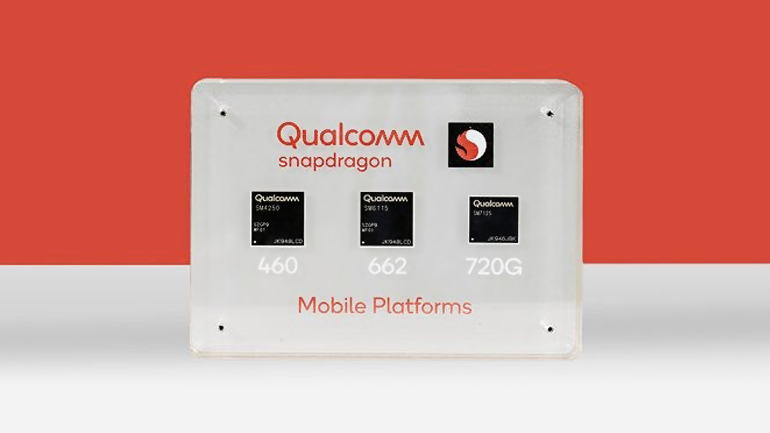
Even though fifth generation mobile communications technology is set to go mainstream, 4G, also known as LTE, isn’t going away any time soon. With this in mind, it is not surprising that manufacturers of telecom equipment continue to develop 4G-focused smartphone processors. US-based Qualcomm Technologies has launched three new Snapdragon mobile platforms aimed at 4G smartphone manufacturing companies. The Qualcomm Snapdragon 720G, 662 and 460 chipsets have been created to enhance user experiences across connectivity, gaming and entertainment applications. In a statement, the company said that these new mobile platforms provide high-speed 4G connectivity, deliver key Wi-Fi 6 features and integrated Bluetooth 5.1 with advanced audio via the Qualcomm FastConnect 6-series subsystems, support Dual-Frequency (L1 and L5) GNSS to improve location positioning accuracy and reliability, and are the first system-on-chip products to support Navigation with Indian Constellation (NavIC) satellite positioning system. Qualcomm said the new Snapdragon platforms also…
In 2020, Apple is anticipated to release its first 5G-enabled iPhone powered by chipsets from Qualcomm and Samsung, according to a report from reliable supply chain analyst Ming-Chi Kuo of TF International Securities. Following Intel’s announcement earlier this month about exiting the 5G modem chip market for iPhones, Apple had to turn to Qualcomm to ensure the supply of a 5G modem chip. The tech-giant is also looking for a second supplier and, in all probability, this will be Samsung. “We expect Apple will likely adopt 5G baseband chips made by Qualcomm (focus on mmWave markets) and Samsung (focus on Sub-6GHz markets) for lowering supply risk, reducing costs and having better bargaining power,” said the analyst Ming-Chi Kuo. Kuo believes that the introduction of a 5G-enabled iPhone could create a wave of upgrades and purchases, especially for the high-end models. “We are positive on the high-end iPhone models’ replacement…
While 5G maintains its dominant position in telecom news headlines, Qualcomm has made a major move towards the realization of this disruptive technology with the announcement of the first fully-integrated QTM052 5G NR mmWave and QPM56xx sub-6 GHz RF modules for mobile devices. These antennas will be used in conjunction with the Snapdragon X50 5G module to achieve the stellar target speeds of 5G networks. “Qualcomm Technologies’ early investment in 5G has allowed us to deliver to the industry a working mobile mmWave solution that was previously thought unattainable, as well as a fully-integrated sub-6 GHz RF solution. Now, these type of modem-to-antenna solutions, spanning both mmWave and sub-6 spectrum bands, make mobile 5G networks and devices, especially smartphones, ready for large scale commercialization,” commented the president of Qualcomm Incorporated. Even though the mmWave signals can offer the critically higher speeds that are essential for this cutting-edge network, they can…
Vietnam’s recent decision to award 5G contracts to Huawei and ZTE signals a crucial transformation in its telecommunications strategy, impacting its VoIP infrastructure. This transition highlights Vietnam’s complex balancing act between global powers, as it embraces Chinese 5G technology despite longstanding Western security concerns. Exploring Vietnam’s evolving VoIP dynamics amid geopolitical shifts offers insight into future telecom trends, emphasizing cost-effectiveness and advanced connectivity.
Orange France is set to revolutionize VoIP communication by partnering with Skylo to launch the Message Satellite service. This initiative will provide direct-to-device services, enhancing connectivity in areas with poor terrestrial signals. Businesses in remote locations can expect seamless VoIP communication, benefiting from advanced satellite technology and robust network infrastructures.
The future of technology lies in embodied AI, a pivotal shift impacting industries beyond imagination. From autonomous vehicles to industrial robotics, this integration reshapes VoIP systems, highlighting seamless data interaction. Companies that harness this synergy will revolutionize VoIP capabilities, ensuring sustainable growth and competitive advantage in the connected world.
The advent of next-gen Wi-Fi 8 technology, spearheaded by TP-Link, promises to revolutionize wireless connectivity. Testing has shown impressive results in data-transfer efficiency, preparing it for future deployment. While Wi-Fi 7 set high standards, Wi-Fi 8 aims to enhance performance, boosting throughput despite numerous connections, benefiting homes and businesses alike.
Verizon is leading an initiative to establish a 6G alliance with major telecom influencers. This aims to strategically define 6G capabilities and innovative applications, avoiding chaotic development. Key players like Ericsson, Samsung, and Nokia join forces with Verizon to shape the future, ensuring 6G networks power real-time AI and smart city solutions.
T Mobile has launched nationwide L4S on its 5G Advanced network, cutting latency and packet loss for cloud gaming, XR, video calls, and remote driving. Built on its standalone core with network slicing, it adapts to real time conditions.
Vodafone Germany has ingeniously transformed a traditional advertising column into a 5G antenna site in Stuttgart, kickstarting a project to enhance urban mobile coverage. Utilizing Ericsson antennas and fiber optic backhaul, it offers 500 Mbps speeds. This innovation expands Vodafone’s 5G network seamlessly, avoiding the challenges of building large cell towers.