2669 Results

Tim

Search

Vodafone Carrier Services, the division responsible for Vodafone’s global trading of voice, network connectivity and messaging services, has announced that the Voipfuture Qrystal solution will be used for monitoring the quality of the company’s end-to-end, IP-based voice network service.  According to Voipfuture, their platform provides advanced voice quality analytics, reporting and troubleshooting by means of signaling and media metrics. The Qrystal  platform acts as a passive monitoring system, and analyzes SIP and RTP traffic in real-time. This technology, patented by Voipfuture, uses fixed time slicing to deliver quality data in five-second units. Quality data is gathered and combined into different levels, thus providing accurate information to assess the quality of overall traffic as well as for single calls. Clive Goodwin, Head of International Voice Services at Vodafone, said, “We designed our Intelligent Routing platform to deliver High Definition voice (HD voice) services across a large number of countries…


Telefonica and Facebook have joined forces to launch an open access wholesale rural mobile infrastructure operator, Internet para Todos (IpT) Peru, together with IDB Invest (Inter-American Investment Corporation) and CAF (Development Bank of Latin America). The project aims to bring faster mobile Internet to rural markets and consequently bridge the digital divide in Latin America. An estimated 20 percent of the Latin American population, which is around 100 million people, lack sufficient access to mobile broadband and therefore are deprived of enjoying the benefits offered by the digital economy. “Our new approach will leverage our network as a service to bridge the digital divide as fast as possible while providing any mobile network operator access to rural markets,” said Teresa Gomes, Managing director of Internet para Todos. “Our goal now is to launch and scale the project in Peru and prove what’s possible to the rest of Latin…

ZTE Corporation and Intel have jointly launched the Light Cloud platform for access networks at the 5G Summit being held at Mobile World Congress 2019 in Barcelona. The Light Cloud solution is based on Intel’s innovative Edge products, impeccably integrated into ZTE’s flagship optical fiber access platform, Titan, thus merging Multi-access Edge Computing (MEC) and Network function virtualization (NFVI). The solution employs lightweight blade servers equipped with Intel Xeon D processors. When embedded in an OLT or BRAS device, the blade servers transform it into lightweight cloud infrastructure, thus reducing high capital costs and making a positive environmental impact. The infrastructure opens up computing and storage possibilities based on telecom access equipment, and allows the deployment and distribution of application-sensitive services. The access layer with cloud features is supported by built-in blade servers, and facilitates the ability to offer a wide range of cloud applications and services, including…

The Mobile World Congress – MWC Barcelona 2019 – is here. More than 100,000 mobile industry insiders, telecom specialists, professionals, analysts, reporters, and admirers of the most advanced devices have gathered to explore the wonders of the latest technology. Tech giants such as Samsung, Huawei, Xiaomi, and Vivo unveiled their innovations just before the show, but here we list some notable smartphones that have been presented at MWC. LG V50 ThinQ South Korea’s LG Electronics has unveiled its first 5G smartphone with a dual screen, the V50 ThinQ. The two screens are independant, enabling users to watch videos on one screen and browse the Internet on the other. Qualcomm’s cutting-edge Snapdragon 855 chipset together with a X50 5G modem will power the V50 model to support high-resolution games and data-rich applications without latency. The phone, with a 6.4-inch OLED full vision display, is equipped with a 4,000 mAh battery and…

The global organization representing the interests of mobile network operators, GSMA, has called for European governments to “safeguard network security and competition” in the telecommunications infrastructure industry. The association has issued a warning to Europe to refrain from activities that would obstruct the use of certain equipment necessary for 5G mobile network development. According to the GSMA, “Actions that disrupt the equipment supply for the various segments of the network (access, transport and core) will increase costs to European operators, businesses and citizens; delay 5G deployment by years across Europe and potentially also jeopardise the functioning of existing 4G networks upon which 5G is intended to be built.” Although no specific company names are mentioned in the statement, the GSMA initiative highlights the industry’s significant endeavor to prevent the application of additional sanctions, similar to those announced by the United States and Australian governments on Chinese vendors Huawei…

VoIP has become an integral part of the day-to-day lives of many people throughout the world, offering a plethora of technological advancements and options, simplifying many communication processes and making interactions more convenient and consumer friendly. VoIP is one of the most talked-about technologies, and its prevalence is anticipated to grow in the upcoming years. Over the last twenty years, VoIP has provided businesses around the world with the convenience of increased mobility, due to constant development and emerging cutting-edge technologies. The usage of VoIP as a service has grown rapidly – between 1998 and 2002, VoIP carried only 1-3% of all voice calls worldwide, but in 2005, VoIP was responsible for more than 200 billion call minutes. With 2019 already underway, let’s have a look at what the future holds for the VoIP communications industry. In particular, we examine the insights and predictions regarding the trends and technologies that will…

Verizon has announced a successful edge computing trial on a live 5G network, conducted using their newly formed 5G test bed in Houston. The company’s engineers used Multi-Access Edge Compute (MEC) equipment and MEC platform software, incorporated in a network facility closer to the network edge, and managed to decrease network latency by half. The test results are important for next generation networks, enabling 5G to support low-latency applications such as Virtual Reality (VR). Low latency refers to minimizing the round-trip time taken by data packets. This is an essential yet enormously challenging attribute for a 5G network, and its high performance requirements. At present, many mobile applications depend on cloud-based processing that is handled in centralized data centers, and the physical distances involved increase latency. According to Verizon, locating the computing power nearer to the users at the network edge significantly decreases the time to deliver services. …

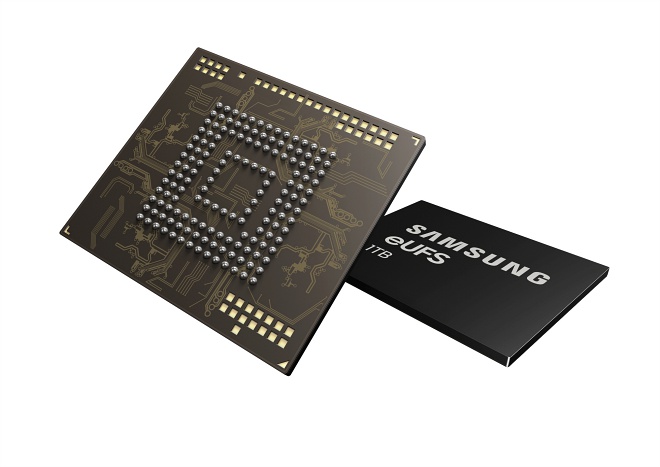
This week, the tech giant Samsung officially introduced the industry’s first 1 TB embedded Universal Flash Storage (eUFS) chip for smartphones. The terabyte-sized native storage solution will considerably enrich the company’s mobile devices, eliminating the need to install additional microSD cards for handling large capacities. Samsung has already begun mass production of the storage chip, however there is no clear indication of when they will be installed in smartphones. “The 1TB eUFS is expected to play a critical role in bringing a more notebook-like user experience to the next generation of mobile devices,” said Cheol Choi, Executive vice president of Memory Sales and Marketing at Samsung Electronics. “What’s more, Samsung is committed to assuring the most reliable supply chain and adequate production quantities to support the timely launches of upcoming flagship smartphones in accelerating growth of the global mobile market.” The new eUFS memory chip measures the same…

Google Voice is finally getting an update with the addition of Voice over Internet Protocol (VoIP), honoring the company’s commitment made in 2017 to make improvements to the application. Social media apps such as Facebook and Instagram have already been using VoIP carried over Wi-Fi or mobile data for voice calls in private or group messages, enabling communications between users through voice messages and video calls. Google Voice has been functioning as a phone call relay system, forwarding calls through another number. However, the app has never used VoIP for carrying traffic, and has been constrained to providing traditional phone connections. There is another Google messaging app, Hangouts, that facilitates audio chat between mobile devices over WiFi. However, this app is intended more for personal use rather than for professional engagements, and a Hangouts Dialer plug-in is required to be able to place calls within Hangouts app. Scott…

The technical support team plays a critical role in a VoIP business, being the initial reference and contact point for customers experiencing technology-related issues. In addition, these important employees are responsible for analysing and resolving system failures and outages, product installation errors, user enquiries and any other technical problems that prevent customers from using an application or service. There is a wide and diverse range of possible technical issues that can occur, depending on the type of telecommunication services provided. Nevertheless, some of the most common VoIP connectivity concerns are audio quality, caller-ID problems, the dropping of calls, and post dialling delay (PDD). Studies reveal that passing on valuable technical advice or providing substantial assistance to customers is the number one method for telecom companies to improve the user experience for their products and services. At voip.review, we have summarised some relevant ideas for VoIP providers to…