412 Results

artificial intelligence

Search

A consortium of nine technology companies – Intel, Cisco, Dell EMC, Microsoft, Hewlett Packard Enterprise, Facebook, Google, Alibaba and Huawei – has been formed in order to create and launch a new standard, called Compute Express Link (CXL). This project will accelerate ever-expanding data workloads, such as high-performance computing, artificial intelligence (AI), internet of things (IoT), rich media services, and cloud applications. Jim Pappas, director of technology initiatives at Intel, said in a statement: “CXL is an important milestone for data-centric computing and will be a foundational standard for an open, dynamic accelerator ecosystem. Like USB and PCI Express, which Intel also cofounded, we can look forward to a new wave of industry innovation and customer value delivered through the CXL standard.” The new cluster of tech giants, described as “the biggest group of influencers driving a modern interconnect standard”, also affirmed the CXL Specification 1.0, which enables…

The Mobile World Congress – MWC Barcelona 2019 – is here. More than 100,000 mobile industry insiders, telecom specialists, professionals, analysts, reporters, and admirers of the most advanced devices have gathered to explore the wonders of the latest technology. Tech giants such as Samsung, Huawei, Xiaomi, and Vivo unveiled their innovations just before the show, but here we list some notable smartphones that have been presented at MWC. LG V50 ThinQ South Korea’s LG Electronics has unveiled its first 5G smartphone with a dual screen, the V50 ThinQ. The two screens are independant, enabling users to watch videos on one screen and browse the Internet on the other. Qualcomm’s cutting-edge Snapdragon 855 chipset together with a X50 5G modem will power the V50 model to support high-resolution games and data-rich applications without latency. The phone, with a 6.4-inch OLED full vision display, is equipped with a 4,000 mAh battery and…

VoIP has become an integral part of the day-to-day lives of many people throughout the world, offering a plethora of technological advancements and options, simplifying many communication processes and making interactions more convenient and consumer friendly. VoIP is one of the most talked-about technologies, and its prevalence is anticipated to grow in the upcoming years. Over the last twenty years, VoIP has provided businesses around the world with the convenience of increased mobility, due to constant development and emerging cutting-edge technologies. The usage of VoIP as a service has grown rapidly – between 1998 and 2002, VoIP carried only 1-3% of all voice calls worldwide, but in 2005, VoIP was responsible for more than 200 billion call minutes. With 2019 already underway, let’s have a look at what the future holds for the VoIP communications industry. In particular, we examine the insights and predictions regarding the trends and technologies that will…

Microsoft has announced that the latest version of Skype for desktops and laptops now offers the option of blurring the background during video calls. This feature works to distinguish and isolate the subject from the surrounding background, and places the focus on the person as the most important component of the scene. This will provide a distraction-free space, and help eliminate any embarrassing moments during video conferencing. This option was first introduced in another Microsoft messaging application, Teams. Last September the company announced their support for the background blur in this collaboration app, introducing new features for the workplace chat platform and Office 365. The blur feature has put Artificial Intelligence (AI) to use, as this advanced technology has been trained to recognize the human form. It is not just the speaker’s face that is in focus, but also their hair, hands and arms, thus creating a smooth…

Verizon has announced a successful edge computing trial on a live 5G network, conducted using their newly formed 5G test bed in Houston. The company’s engineers used Multi-Access Edge Compute (MEC) equipment and MEC platform software, incorporated in a network facility closer to the network edge, and managed to decrease network latency by half. The test results are important for next generation networks, enabling 5G to support low-latency applications such as Virtual Reality (VR). Low latency refers to minimizing the round-trip time taken by data packets. This is an essential yet enormously challenging attribute for a 5G network, and its high performance requirements. At present, many mobile applications depend on cloud-based processing that is handled in centralized data centers, and the physical distances involved increase latency. According to Verizon, locating the computing power nearer to the users at the network edge significantly decreases the time to deliver services. …

As a whole, the telecommunications industry has been traditionally male-dominated. However, the trend is rapidly changing as this business sector becomes increasingly augmented with talented women having profound knowledge and skills, and influencing an industry where high-ranking female officials were a rarity until recently. Here is the list of the top ten women in the telecommunications industry, selected for their technical and business know-how, extensive experience, leadership and most significantly, their influence. Michelle Bourque Michelle Bourque is Senior Vice President, Product, Marketing and Access Strategy for BCE Nexxia, a wholly-owned subsidiary of Bell Canada. The company provides wholesale services, including voice, broadband, hosting and co-location, and IP connectivity. As the leader of a team of product and marketing professionals, Michelle has introduced innovation and fresh perspectives to the wholesale marketing and product divisions. According to Michelle, women already have a significant presence in the telecoms sector, and…

The Finnish telecom equipment manufacturer Nokia has officially announced that its plant in Chennai, Southern India, has started manufacturing their 5G New Radio (NR) based on the 3GPP 5G New Radio Release 15 standard. “This is another big leap towards the ‘Make in India’ vision as our factory continues to contribute to the Indian economy and the country’s growing profile as a manufacturing and engineering hub. Nokia was the first to leverage the skills and capabilities in India and start manufacturing telecom networks equipment in the country in 2008, and develop the local supply chain for various components. We are now pioneering 5G manufacturing in the country, making India and the world ready for 5G,” commented the senior vice president and head of the India Market at Nokia, Sanjay Malik. Nokia’s factory in Chennai has maintained its position as one of largest and leading plants in the country by…

At the recent Sino-German Economic Forum, China Mobile and Nokia signed a one year framework agreement valued at 1.36 billion euro (9.927 billion yuan) to support the Chinese operator’s transition to 5G infrastructure, while maintaining seamless connectivity. Under this agreement, the Finnish corporation will be providing the Chinese telecom with cutting edge end-to-end technologies for the next generation network, in addition to mobile, fixed, IP routing, optical transport and customer experience management technologies along with their service expertise and support. The two companies have been in partnership since 1994, when Nokia supported the first GSM call on China Mobile’s network. In addition to collaborating on 5G, both companies are moving forward together and have agreed to conduct research and tests on artificial intelligence and machine learning. “This is a highly significant agreement with our longstanding partner that consolidates Nokia’s position as a leading provider of next-generation technologies and services in…

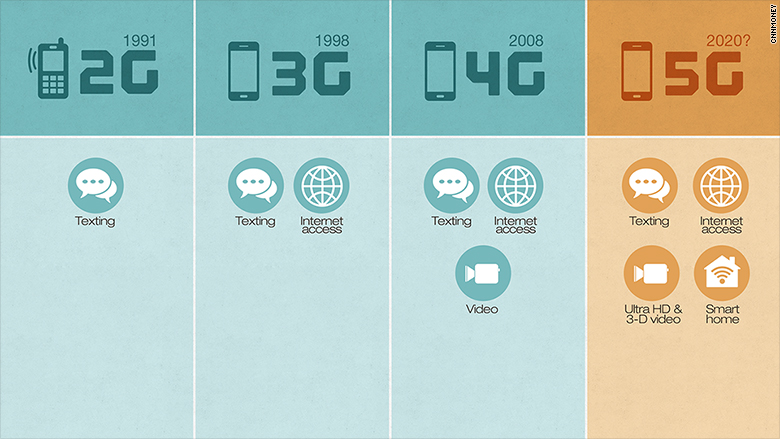
After years of hype, we are looking forward to the impending rollout of 5G networks. This transformational technology will lay the foundation for many future services and change how we view productivity. But how will 5G affect you? Speed and responsiveness It is not yet possible to state definitively what network speeds will be reachable, but it is fair to say that the biggest benefit of 5G to the average user will be the speed of this service. Early estimates have shown that data rates could be up to a thousand times faster than 4G, potentially exceeding 10 Gbps. In practical terms, everything we currently do on the Internet would be significantly faster, and these speeds would enable users to download an entire HD film in a few seconds. Responsiveness or latency refers to the time between a request and a response. The ultra-low latency of 5G will result in response…

The investment required to upgrade a network to support standalone 5G technology is important. JP Morgan think this is the reason why Telecom companies stocks did not do so well last year. There is a serious concern that the investment might not be as effective as expected. The lack of return put an important shade on some valuation for some asian (China, Japan and South Korea) and Australian telecommunications stocks. Those worries could be explained as the daily applications and advantages of 5G technology are yet to be seen and to be invented. James Sullivan,head of Asia ex-Japan equity research at J.P. Morgan explained “It’s not really about faster download speeds,” he said. “It’s about internet of things, autonomous vehicles and things of that nature for which no one understands a monetization case for networks yet.” 5G will not only be customer centered but also will help companies in processing…