947 Results

cloud communication

Search

IPFone, a provider of cloud-based business unified communications and telephony services, together with Ribbon Communications Inc., a global provider of real time communications software and network solutions to service providers, enterprises and critical infrastructure sectors, announced that they are making use of Ribbon‘s Intelligent Edge portfolio to ensure that their customers are able to seamlessly work from home during the COVID-19 pandemic. Ribbon‘s EdgeMarc 2900, deployed at several IPFone sites in various states, helps support IPFone’s business customers as the company experiences an increase in its network usage. EdgeMarc devices are located at the edges of the customer network to ensure the successful deployment of IP-based communications services that improve voice quality, security and visibility on the customer network. Also, the EdgeMarc 2900 allows IPFone to easily adapt  to the smallest or largest customer installations, while providing secure service delivery capabilities. This architecture enables the company to proactively keep…

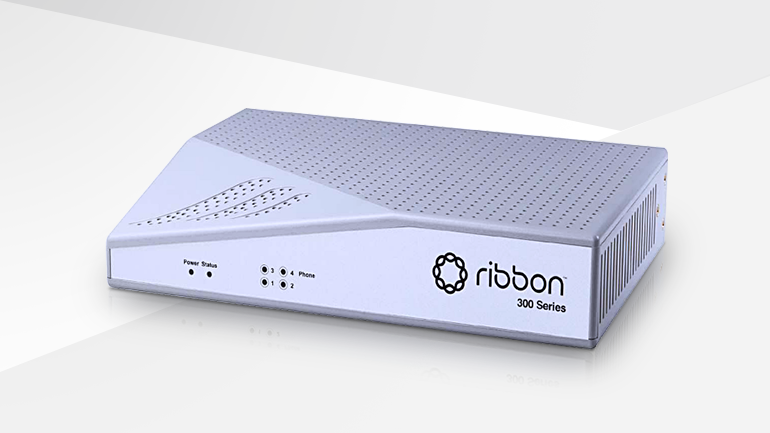
The US technology company Ribbon Communications has introduced its new EdgeMarc 300 Series to provide small businesses, home office and branch office customers that currently have analog voice infrastructure, with an easy and cost-effective way to capitalize on IP-based voice services. The cloud solutions provider said that the EdgeMarc 300 is part of the recently launched cloud-based Ribbon Next Generation Intelligent Edge portfolio, which securely connects and enhances enterprise voice and data applications, including Microsoft Teams. This portfolio of edge solutions delivers service assurance, advanced analytics, security, policy and routing functionalities for cloud communications applications. Ribbon’s EdgeMarc 300 is a survivable branch office solution that supports the integration of analog endpoints and the public switched telephone network (PSTN), as well as Session Initiation Protocol (SIP) calls. This gateway provides connectivity between analog and SIP devices, enabling branch offices to rapidly migrate analog phones to a SIP-based network and communicate seamlessly with…

Audian, a Unified Communications (UC) solutions provider seeking to redefine the telecom industry, and Xarios Technologies, an independent software vendor and developer of advanced telephony applications, have entered into a strategic alliance agreement to bring the next generation of real-time call analytics and business insights to VoIP telecommunications systems. These leading companies in the telecom environment will help their end customers with new applications and provide integration between platforms that facilitate in-depth information and data-driven business solutions. Brandon Bazemore, CEO of Audian, said, “We pride ourselves on maximizing our customers’ Telecompetence by leveraging the latest in software and technology to simplify the complexities once associated with telecom, giving our customers back time and energy to focus on growing their business. Our partnership with Xarios only extends our dedication to these principles, and we look forward to learning from and utilizing their approach to call analytics and reporting to deliver performance…

Juniper Network, a provider of high-performance networking and cybersecurity solutions, has been selected by the UK’s telecoms giant British Telecommunications (BT) to deliver its Network Cloud infrastructure initiative. This arrangement will help support the rollout of BT’s upcoming unified cloud networking platform, which will integrate the company’s networks, including 5G, Wi-Fi and fixed-line, into one virtualized service and enable more efficient infrastructure management and implementation. This new and more flexible network infrastructure will also generate a range of innovative applications that support services such as Internet access, TV and business network functions, improved voice and video delivery, and scalability. The Network Cloud platform will be built according to a common framework, and shared across BT’s offices throughout the UK and globally. “This move to a single cloud-driven network infrastructure will enable BT to offer a wider range of services, faster and more efficiently to customers in the UK…

NTT Communications Corporation (NTT Com), the ICT solutions and international communications business within the NTT Group, is promoting the expansion and development of its European data center platform with the launch of their Amsterdam 1 Data Center (AMS1). The group’s first data center in the Netherlands has been opened by NTT Com’s subsidiary E-Shelter, which provides secure environments for housing and connectivity of IT and network systems. Tetsuya Shoji, President and CEO of NTT Com, said in his official opening speech: “I am delighted to open our latest state-of-the-art data center campus located in Amsterdam, one of the key internet hubs in Europe”. The carrier-neutral E-Shelter’s AMS1 data center will have a capacity of up to 40 MW IT load spread over a 16,000 square meter campus and, as NTT’s 21st data center in Europe, will leverage more than 400 MVA power capacity across the continent, with plans…

ZTE Corporation and Intel have jointly launched the Light Cloud platform for access networks at the 5G Summit being held at Mobile World Congress 2019 in Barcelona. The Light Cloud solution is based on Intel’s innovative Edge products, impeccably integrated into ZTE’s flagship optical fiber access platform, Titan, thus merging Multi-access Edge Computing (MEC) and Network function virtualization (NFVI). The solution employs lightweight blade servers equipped with Intel Xeon D processors. When embedded in an OLT or BRAS device, the blade servers transform it into lightweight cloud infrastructure, thus reducing high capital costs and making a positive environmental impact. The infrastructure opens up computing and storage possibilities based on telecom access equipment, and allows the deployment and distribution of application-sensitive services. The access layer with cloud features is supported by built-in blade servers, and facilitates the ability to offer a wide range of cloud applications and services, including…

A cloud-hosted, VoIP-powered PBX is an attractive and preferred option for a modern business telephone service. It is extremely cost effective, available for use anytime and almost anywhere, and requires none of the hardware investment that traditional on-premises systems needed in the past. With maturing technology and the desired convenience in business communication, now is the right time for change. Switching to a hosted private branch exchange (PBX) may sound complicated, however a well-thought-out transformational process can be smooth and hassle-free. Let’s discuss the main points to consider when moving from a traditional voice system to a cloud PBX. PBX systems – traditional vs virtual To begin with, it is important to understand the main differences between a traditional PBX and a cloud PBX. A legacy PBX is an enterprise phone system stored and hosted on the customer’s premises, and consists of specialized hardware,  generally  connected using circuit switched networks.…

The Lithuanian mobile operator BITĖ has launched a new Smart call management service oriented towards its business customers, delivering full PBX services to mobile users. While cloud-based PBX services are now generic, BITĖ’s Smart call management service has fulfilled their specific and innovative requirement that the solution must be delivered over the standard mobile voice network, and should not require data services or the use of an app on the mobile device. The result is a seamless, simple-to-use, fully featured and high availability business voice service, accessible from any mobile device and being operating system agnostic. The solution architecture enables instant deployment of phone system extensions without any action required by the end users (business employees), eliminating the time and effort required by the business IT department and BITĖ’s customer service to configure, manage and support the service. “Phone calls constitute an essential and integral component of all…

When using a cloud PBX, customers have access to advanced features and enterprise-level functionality, while enjoying reduced infrastructure costs and minimized system administration concerns. However, you should diligently compare providers to ensure that you do not subscribe to a service that does not fit your needs and goals. This article lists some points to consider before committing to any hosted PBX phone service provider and should assist you in choosing a service that meets your communication needs. Are my feature set requirements satisfied? Before you start looking for a provider, you must compile a list of features that are essential to your business model and operational requirements, and also consider what features you might need in the future. In many cases, the cloud PBX provider charges for a specific set of features, or bills on a per-feature basis. Therefore, it may be useful to differentiate between “must have” features, and…

When we talk about the future of corporate communication networks, most experts point to VoIP technology as the future. However, many companies still opt for older platforms that, although offering fewer features, can still be quite reliable. The most famous of them goes by the name of SS7. But what are the fundamental differences between VoIP and SS7? In this article, we will examine what each of these technologies does, their advantages and disadvantages, and in what situations they present themselves as the best options for the communication structure of companies around the world. SS7: An old technology, but it may still be necessary SS7 is the abbreviation for Signalling System 7: a digital network dedicated and used for initializing and controlling voice calls. Each signaling point on the SS7 network is uniquely identified by numeric point code. These are loaded in signaling messages exchanged between signaling points in order…