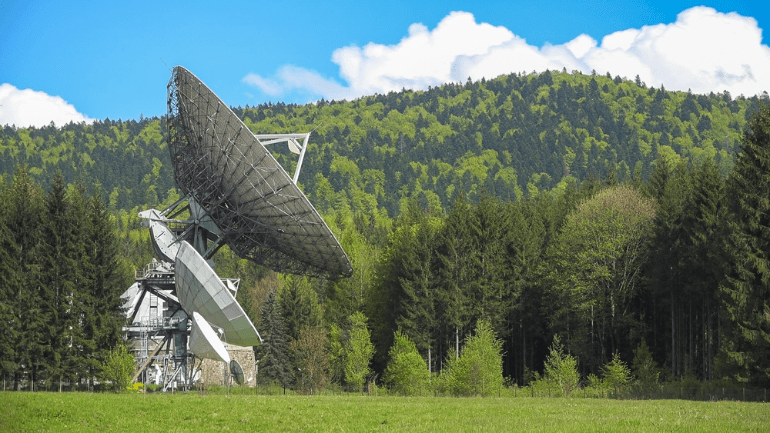
Orange has opened Europe’s first gateway for Telesat’s Lightspeed low-Earth orbit satellite network. The site sits at Bercenay-en-Othe, a rural French teleport near Paris. The move prepares both companies for commercial services expected in early 2028.
The facility has deep telecom history. Orange built it nearly 50 years ago for satellite communications. Jean-Louis Le Roux, EVP for Orange International Networks, called the new gateway “a revival of the location with new space technology.”
He also highlighted the site’s heritage and layout. “It’s a very historical site for Orange … We have 46 antennas ranging from one meter to 32 meters. We call the antennas our ears, even if we are not listening to anything … The landscape is quite beautiful. It’s in the middle of nowhere in the country and you can see all the ‘ears,'” he told Light Reading.
To host the new gateway, Orange removed an unused 32-meter GEO antenna. The Telesat installation adds ten smaller antennas, from one to four meters high. The site’s low electromagnetic noise also helps satellite operations.
This upgrade gives Orange a stronger role between space and terrestrial networks. The company will connect the gateway to Telesat’s planned Paris point of presence. That link will support business and mission-critical applications.
Orange views satellite as part of a wider connectivity mix. Its international network team manages submarine cables, fiber routes, and satellite links. A dedicated satellite unit of around 100 people supports those services.
Le Roux said the business need remains clear. “We consider satellite a full complement to our terrestrial and submarine networks. Today, satellite is only 2% of total communication. It’s not a lot but that 2% is very important. This allows to cover remote areas with low coverage. It allows also to cover emergency situations when our terrestrial networks are no longer working,” he said.
For Telesat, Europe becomes a key foothold. The company plans 24 landing stations worldwide for its LEO constellation. Its initial Lightspeed network should include 225 satellites.
The system uses optical links between satellites. These laser links can keep traffic in space for longer. That helps customers control where data returns to Earth.
Luke Pearce, principal analyst at FDM CCS Insight, said this design matters for sensitive users. “This gives customers greater control over where their data is routed and where it ultimately comes back to Earth, potentially avoiding untrusted or foreign terrestrial networks. That is valuable for data sovereignty, security and defense applications,” he said.
Still, the plan faces pressure. Telesat must deploy satellites, scale operations, and meet enterprise expectations. It also enters a crowded market with Starlink, Amazon Leo, and other LEO players.
However, Telesat may benefit from its Canadian identity. European governments want more choice in critical infrastructure. A non-US option could appeal to defense, enterprise, and public-sector customers.
The Bercenay-en-Othe gateway therefore signals more than another satellite site. It shows how established telcos can reuse legacy assets. It also shows how space networks now support mainstream telecom resilience.