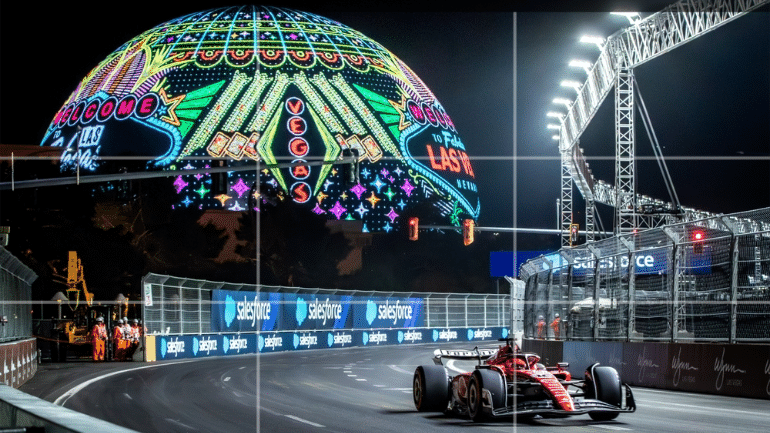
T-Mobile has turned the Las Vegas Grand Prix into a major network showcase.
The operator’s 5G network now supports much more than fan connectivity. It powers live broadcast links, ticket scanning, payments, security, crowd monitoring, and shuttle tracking. The result is a high-profile test of wireless infrastructure under extreme pressure.
At the Las Vegas Grand Prix, the network supported the primary Apple TV broadcast feed. It also connected cameras placed around the track. The race was won by Max Verstappen after 50 laps.
The deployment used public and private connections on one wireless foundation. T-Mobile combined network slicing, millimeter wave, and C-band spectrum. Network slicing creates dedicated lanes for specific services. That helps separate payment traffic from video and public mobile use.
Grant Castle, T-Mobile’s senior vice president of RAN engineering, said the project grew over time. The company first supported a few scanners and payment terminals. It now connects more than 500 ticketing and point-of-sale devices.
The payment traffic does not need huge bandwidth. However, it needs speed and reliability. Any delay at a gate can quickly create long queues.
Broadcast raised the highest bar. Castle said Formula 1 needed strong proof before trusting wireless links. “The biggest, most difficult thing is broadcast TV,” Castle said. “The quality has to be sparkly perfect. It has to be 100% reliable.”
That statement captures the wider challenge for mobile operators. Stadium and event networks must now carry business-critical services. Fans still expect fast uploads and streaming. Event organizers also demand uptime for safety and revenue systems.
Wireless links brought clear flexibility. Crews could use drones, rooftop cameras, and smartphones with broadcast software. Selected fans even helped capture live views from the venue.
“The quality of cameras and smartphones has gotten dramatically better,” Castle said. “They [the F1 fans] become the camera operator. You have this flexibility that they’ve never had before,” he added.
Still, event-grade wireless needs careful planning. Dense crowds can strain capacity. Millimeter wave offers high speeds, but over shorter distances. That makes small cells and temporary cell sites essential.
T-Mobile also used AI cameras from Queues for crowd heatmaps. The system alerted staff when lines became too long. Shuttle operations used IoT devices from WeTraQ to monitor vehicles and battery levels.
The operator also demonstrated physical AI using a Figure AI humanoid robot. A prioritized network slice supported its low-latency connection. Castle linked this area to 5G Advanced and future 6G networks.
“We think we can get pretty far with 5G Advanced. But it’s clear to us that there are some key architectural changes that are going to be even better for physical AI,” he said. “As we look forward and we see physical AI growing, we think 6G is going to be the ideal, long-term answer.”